Quantcast
Channel: vordelfeeds
Viewing all 236 articles
Browse latest View live

Two job postings for Axway API Gateway experts - one in Phoenix and one in New York City


Cross-Domain Security: Not only for government anymore

$
0
0
Next Tuesday, March 11, there is another chance to catch the GovInfo Security webinar on "Solving the Identity and Access Problem Across Domains".

Although cross-domain security is often associated with government, it's also very relevant for other verticals such as healthcare. In healthcare for example, it's often important to use standards such as SAML to convey identity or attribute info across domains, while having privacy safeguards in place.

The webinar covers the role of the Gateway as an "Identity Bridge", which is an important architectural design pattern used to map identity and attributes across domains, taking into account the different security and identity technologies that may be used (SAML, Kerberos, OAuth, or proprietary tokens like SiteMinder or Oracle Access Manager).

How to call an API which uses a Self-Signed Certificate, using the Axway API Gateway

$
0
0
The Axway API Gateway, as the name suggests, is often used as a gateway in front of APIs / Web Services. The connection to the API behind the API Gateway often is over SSL. If this connection uses a self-signed certificate (i.e. not VeriSign or another global CA), then how do you configure the trust for this connection?

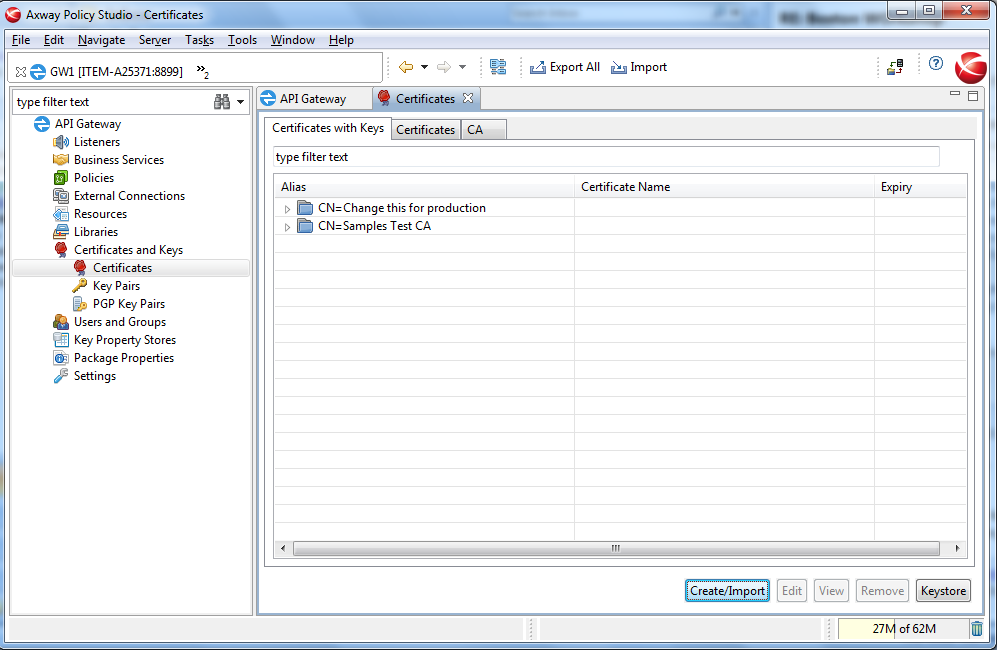
The first step is to import the certificate into the "Certificates" section of Policy Studio. To do this, click on the "Create/Import" button, which you can see on the bottom of the screenshot below:


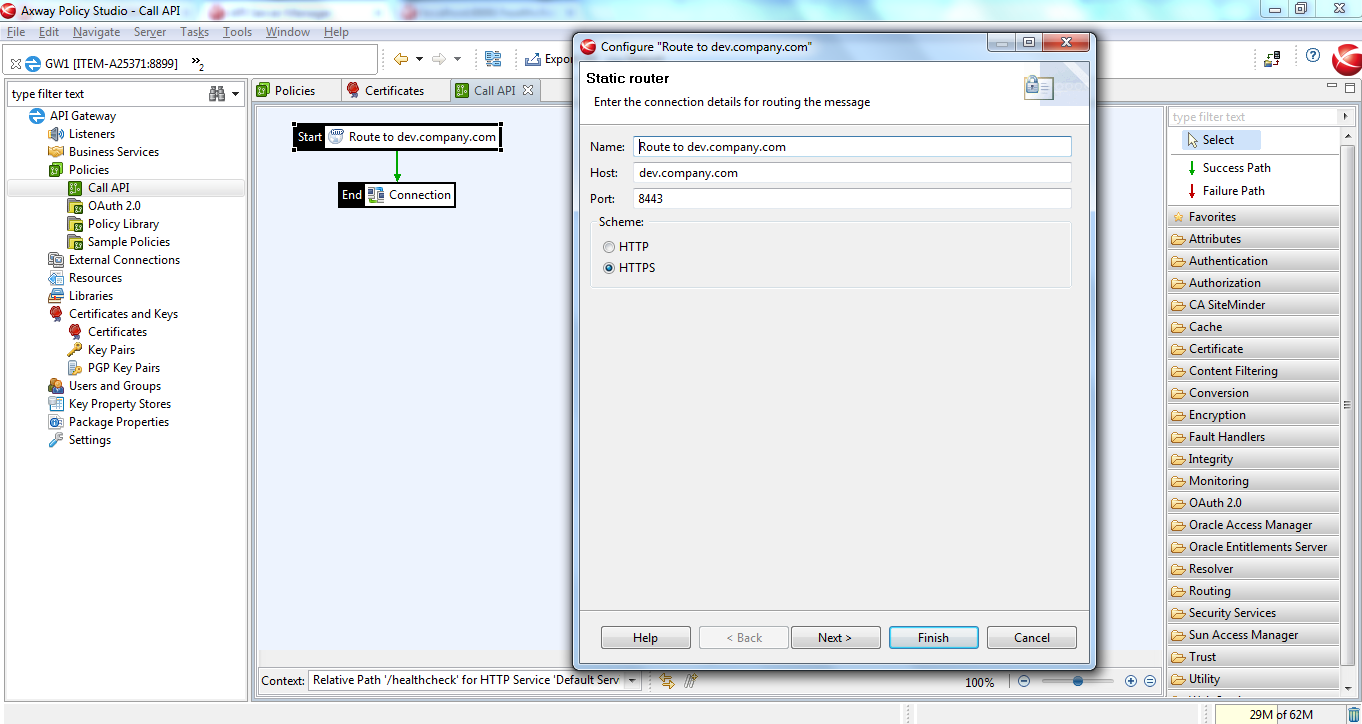
Once you've imported the cert, then you need to use it in a policy. In the example below, I have a simple routing policy which will route to a backend server over SSL. The first step is to use a "Static Router" filter in order to enter the backend server name (in this case "dev.company.com") and select the radio button which specifies that I'm connecting over SSL:


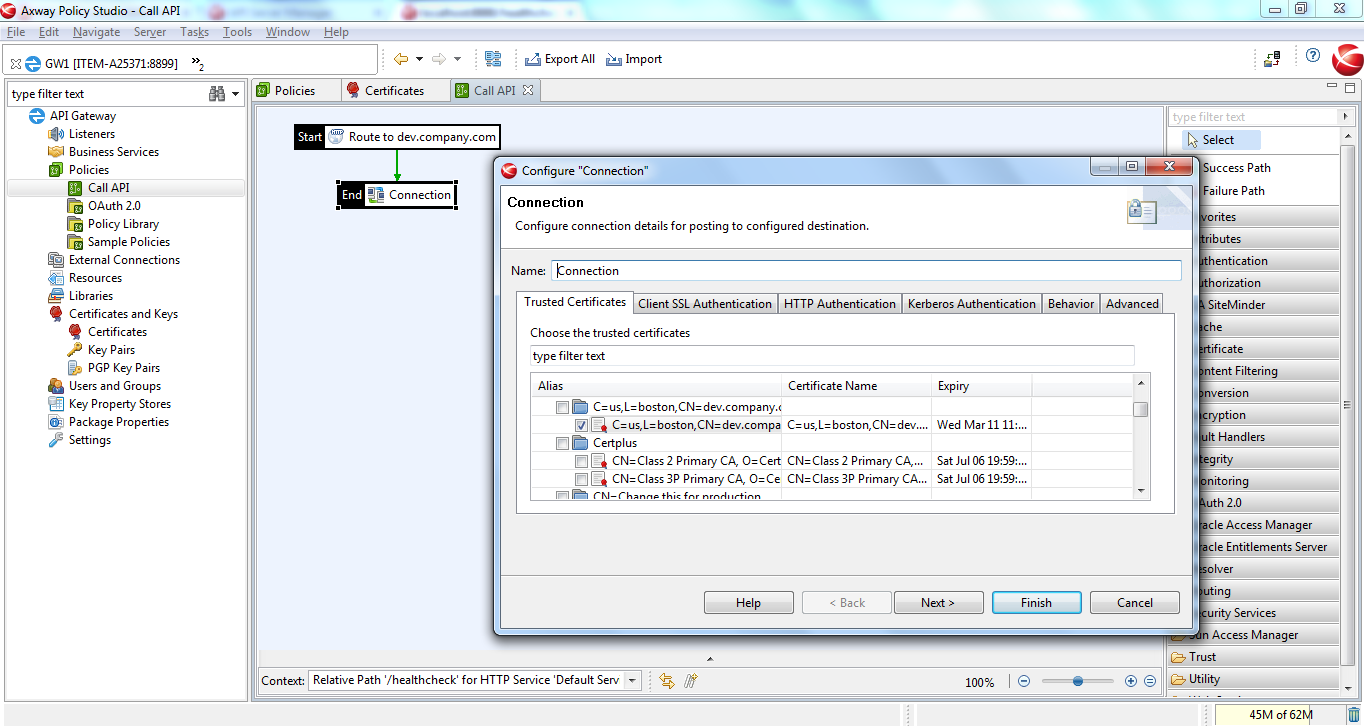
I then follow this with a "Connection" filter, and I make sure that the certificate which I imported earlier is checked under "Trusted Certificates", as shown below:


Now, I apply this policy to a path off the API Gateway. Because this policy applies to any relative path, I can call a path like "/myAPI" or "/myOtherAPI" on the API Gateway, and it will be routed to the backed server using the same path. That is all you need to do to connect to an API / Web Service over an SSL connection which uses a self-signed certificate. 

Innovator spotlight: Essent using APIs to enable a Self-Service Portal and Mobile Apps, powered by Axway

$
0
0
Essent is the largest energy company in the Netherlands, and has a significant API deployment which powers a self-service portal as well as mobile apps. At our Axway API Workshop recently in Brussels, Menno Abbink, Senior Enterprise Architect in the CIO office at Essent, spoke about how their API program.

I'm pleased to say that now we are spotlighting Essent's API innovation in a case study on the Axway website. The case study is a free download, and here is an excerpt:
Today, Essent’s two million customers can manage their utility contracts online using the Customer Self-Service Portal. The portal contains about 140 web services, providing an end-to-end self-service capability.

The underlying web APIs can be reused as needed for other applications, enabling Essent to react quickly to market trends and launch its own marketing campaigns. Taking advantage of this, Essent runs a multitude of web-based apps for its marketing activities, all of which can use the same “API backplane” enabled by the Axway API Gateway.

“Four mobile applications are available within the iTunes App Store and Google Play,” said Abbink. “These apps use Axway API Gateway as a secure environment in which customers can log onto the back-end systems to retrieve and modify their information." 
http://www.axway.com/resource-library/case-study/essent
This is a leading-edge API deployment, which I encourage anyone interested in large scale API delivery to check out.

API Workshop in the Netherlands, April 3 - with Essent, Open Bank, and Axway - Covering Mobile, OAuth, Cloud

$
0
0
Following our recent API Workshops in Australia and New Zealand, the next port of call is The Netherlands, where we are running an API Workshop on April 3 in Utrecht.

For people who haven't been to an API Workshop, here's a quick description of the format: It's a half-day event, beginning with presentations by real live API practitioners speaking about the experiences. Following these presentations and Q&A, we then look at the technology behind APIs. At the Netherlands event, I'm very pleased to say that we have two great speakers lined up:

Firstly there is Simon Redfern from the Open Bank Project. I've followed the innovative work of the Open Bank Project for a while now. Here's a great introduction to their work by Tom Groenfeldt at Forbes. Simon will be speaking about how APIs enable a bank to operate as a platform.

The second speaker is Menno Abbink from Essent (largest electricity utility in the Netherlands). Menno has deployed APIs in the Cloud, on Amazon Web Services, and in fact shared the stage with Werner Vogels (CTO at Amazon) to speak about them at last year's AWS Summit in Amsterdam. Menno gave a fantastic talk at our last API Workshop in Brussels, covering APIs for household electricity usage and electrical vehicles. At the API Workshop on April 3, Menno is speaking about "Cloud to Ground integration", linking from APIs in the Cloud to an on-premises ESB. Here is a great introduction to Menno's work in this profile by Jan Stafford at TechTarget.

So it really is a privilege to have such great speakers lined up for the API Workshop. Following their talks, we'll then enter the "workshop" part of the API Workshop. We will be looking at how to deliver some of the technologies which they cover - including Cloud-to-Ground integration (bridging using the SalesForce API), security for APIs (technologies such as OAuth 2.0 in action) and mobile (walking through how to build a mobile app accessing APIs which are exposed through an API Developer Portal). We'll also see HTML 5 WebSockets in action. Register for the API Workshop for free here, or click on the "Register Now" button below.


API Workshop, April 3, 2014 - Hotel NH - Utrecht - From 9:30 to 13:00

Speakers:

- Simon Redfern: CEO of TESOBE and founder of the Open Bank Project | "Bank as a platform, transparency as an asset. How the Open Bank Project enables an innovation ecosystem".

- Menno Abbink: Senior Enterprise Architect, Essent 
 | 
“Powering the Hybrid Cloud – How APIs enable Cloud to Ground IT Integration”


Mark O'Neill : VP Innovation, Axway. Former Vordel co-founder  | “Designing Secure APIs for B2B, Cloud, and Mobile"

Technical API Workshop:
 
·         Practical workshop walk-throughs showing how and why you can leverage and manage APIs as part of a strategic enterprise engagement strategy:
o    Understanding REST API Security - How to secure REST APIs: Where do OAuth 2.0 and API Keys fit in?
o    Deploying an API Developer Portal - Developer management, API Catalog, and self-registration for developer groups
o    Mapping Cloud identity to enterprise identity - How to enable Single Sign-On with Google ("Cloud Login") via APIs
o    See HTML 5 WebSockets in action for real-time web data - Full duplex streaming of data, for next-generation Web APIs
o    OAuth 2.0 to Microsoft Office365 and OneDrive - How to bridge identity to Microsoft Cloud services 
o    Design and deploy an Android mobile app using APIs  - Java walk-through of the process of calling mobile APIs


Registration is free, so...


API Workshop:

Keynote speakers:


Simon Redfern
CEO of TESOBE and founder of Open Bank Project
openbankproject.com

Menno Abbink
Senior Enterprise Architect,
Essent


Mark O'Neill
VP Innovation - Axway
(co-founder, Vordel, acquired by Axway)

Date:
3rd April 2014

Location :
Hotel NH - Utrecht
Jaarbeursplain, 24
3521 AR Utrecht
The Netherlands

Time:
09:30 - 13:00 (cocktail lunch)

Going Dutch - upcoming Cloud and API events in the Netherlands over the next 10 days

$
0
0

Shortly I'm departing for the Netherlands for three events - hope to see you at one or more of these:

Thursday 27 March:
I'm speaking at the API Strategy event in Amsterdam as part of the Security and Testing panel, with folks from Intel/Mashery, WS02, and Twobo.  Looking forward to some good discussion on API security and API testing.

Tuesday 1 April:
I'm speaking at the Cloud Security Alliance SecureCloud event, also in Amsterdam. My talk is on protecting your Cloud APIs from Denial-of-Service. Look like some great sessions there from Coca Cola, from telecoms providers including BT and Belgacom, and from many governments.

Thursday 3 April:
Along with Simon Redfern from the Open Bank Project and Menno Abbink from Essent, I am speaking at the API Workshop event in Utrecht. We'll be covering hand-on examples of connecting to SalesForce APIs, OAuth 2.0, and developing an Android app to use APIs - more info in this blog post yesterday.

Another API Breach - this time Tesla

$
0
0
Vincent Papaleo in Belgium's L'Echo has written an article this week about the API breach discovered in Tesla's API ("On peut hacker une Tesla!"). This is just one in a series of recent API vulnerabilities, following Snapchat and Buffer and others, but is the first to apply to an Internet of Things case.

The good news is that there is a solution: Secure your API. The recommendations for protecting APIs from attack still apply: Apply API throttling and quotas, adopt a "Deny by Default" posture for your APIs, have full visibility of your API usage, and get alerts on anomalies. This isn't the last API vulnerability story we'll see. As we said at the time of the Snapchat API breach: Don't let your API be next.

Heartbleed

$
0
0
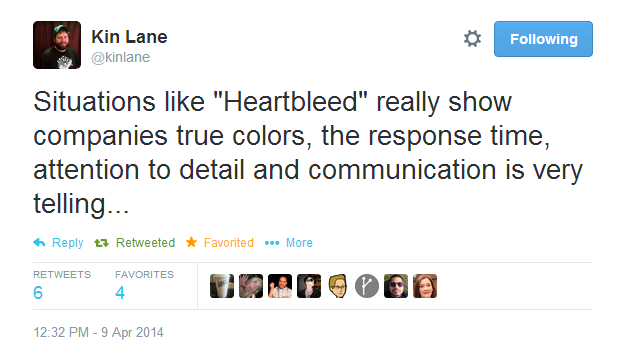
Once again Kin Lane nails it, saying that the response to the Heartbleed OpenSSL vulnerability says a lot about a company:

I'm happy to say that the Axway support team has reacted extremely fast to Heartbleed, producing support notes for Axway's many products which I am equally happy to say are not affected by the vulnerability. This includes the API Gateway, formerly known as the Vordel Gateway. Just take a look at the screenshot of the Axway support portal below, to see all the new Knowledge Base articles about Heartbleed. And if you're a customer, login and check all the Knowledge Base articles at support.axway.com.


Heartbleed mitigation for Web APIs - Catalog your APIs, and apply a Gateway control point

$
0
0
Gary Oliffe at Gartner has an insightful blog post today about how the Web API angle for Heartbleed has been largely ignored. It reminds me of the DoS attacks on banks this time last year. Everybody seemed to focus on the banking websites which were brought down, but not on the Web APIs which also suffered (and rendered some banking apps unresponsive). People naturally focus on what they can see - websites - not on what they can't see - Web APIs.

Gary writes:
With all the media coverage of Heartbleed over the last few days it occurred to me that there has not been nearly enough coverage given to the impact of Heartbleed on web APIs, both from the perspective of a consumer and provider.
http://blogs.gartner.com/gary-olliffe/2014/04/16/heartbleed-hit-your-apis-too-manage-those-dependencies/
He goes on to talk about how an inventory of the APIs you use (internal and external) is vital, writing "You need to know the services are you using, the services are you providing, who is using them, what you and the other party need to do to protect yourselves and whether it has been done". 

I couldn't agree more. The first step to managing your APIs is to catalog them. I've written before about the importance of the API Catalog, both for consumers (in an API Developer Portal) and also for administrators to keep track of the APIs which they are managing. With Axway, the API Catalog itself is available as a Web API (using JSON), which can be customized.

Complimenting the API Catalog is the API Gateway. An API Gateway is especially important for responding to Heartbleed because it provides a control point where you can perform virtual patches. If clients are accessing APIs via the API Gateway, that is the point where you ensure that security rules are applied. An API Gateway provides a level of virtualization in front of the actual APIs themselves, providing a point to quickly respond to issues such as Heartbleed.

So, the combination of (a) an API Catalog, providing an inventory of APIs your organization uses, and (b) an API Gateway to enforce security rules and apply "virtual patches", is important to deal with security events such as Heartbleed.

Healthcare Webinar today - Enforcing HIPAA Policy on Cloud Services

Logging and reporting custom variables in Axway API Analytics

$
0
0
API Analytics is important to solve what is sometimes called the "Cinderella Problem". i.e. "Who's been using my APIs?". As well as monitoring your APIs, you often need to look into the API traffic itself, and pull out custom variables such as Customer IDs. These variables could come from within JSON (using the JSON Path filter to read it) or perhaps from the contents of a parameterized URL. One of the neat features of Axway's API Gateway and API Analytics is that you can configure a custom variable to be logged, for viewing in API Analytics. See below for a screenshot of how this is configured:


Analyst Steve Craggs and the GSMA's Tim Haysom confirmed for API Workshop in London, May 21

$
0
0
I'm excited to say that we have some great speakers lined up for our API Workshop event in London on 21 May. For those of you who have not been to one of these events before, it's a simple format. It mixes analyst speakers and practitioners, and provides technical examples covering APIs, SOA, Cloud and Mobile. So, a good mix of practice and theory.

Recently we ran API Workshops all across Australia and New Zealand (speakers included Ben Kepes of Forbes, plus ANZ Bank and the New Zealand Government), in the Netherlands (speakers included the OpenBank Project and Essent), and worldwide.

Registration is free, and all are welcome: security people, mobile developers, architects, and anyone interested in APIs in general.

Here's the agenda for the API Workshop in London on May 21:

Firstly, there is Steve Craggs (@stevecraggs), an analyst from Lustratus Research who covers SOA Governance and API Management. Steve was at our API Workshop last year as an attendee, and provided much insightful input from the floor. So now we have him on the stage! Looking forward to what Steve has to say, from his analyst standpoint, about SOA and APIs.
Next is Tim Haysom (@haysom_runner) from the GSM Association (GSMA). One of the things which Tim will be covering at our API Workshop is identity, including identity info from mobile devices. Combined with the Cloud identity APIs examples in the hands-on workshop ("Login with Google" etc), this should make for an interesting discussion. Tim is an excellent speaker who I recently saw present at API Strategy in Amsterdam.
Fresh from his Scandinavian swing on the Nordic APIs tour, where he delivered API security insights, Axway's own Tom Burnell will be covering case studies of API Management and SOA in action. Tom brings a practitioners viewpoint, having worked with some of the largest companies in the UK and beyond, architecting API Management and SOA Governance infrastructure.

I'll also be speaking about the importance of an API Portal for engaging developers to the API Economy. And, one of the key features of our API Workshops is the hands-on part. We will see exactly how to leverage an API Portal in order to publish APIs. We'll see how a mobile app is developed to consume APIs. And, we'll see brokering to Cloud services, such as SalesForce, in action. We'll also see HTML5 WebSockets in action. This is all covered, in detail, in the tech lab part of the event. So it's more than just presentations - you also leave with info on how API management is deployed in practical terms.

And we have a fantastic location for the API Workshop. It's taking place at the St Paul's Roof Pavilion of the Royal Festival Hall on London's South Bank. Last June we ran an API Workshop event at the same venue: here a photo I took from the balcony then, on a beautiful sunny day in London.


Here is the form to register. The event starts at 8.30am and runs all day. I look forward to seeing you there!

Register for the API Workshop


Your email will not be shared or sold to a third party.
Axway respects your privacy.

Virtual Patches for IoT: Now more than ever

$
0
0
When Gunnar Peterson and I wrote about the security considerations for Internet of Things, one of the key items was patching ("Vulnerabilities will be found in IOT systems, but how will they be patched? IOT systems require management systems for patching and versioning"). The problem is that Internet of Things devices are often difficult to update. There isn’t an equivalent of a “Patch Tuesday” for a wristband, or a Wi-Fi-enabled smart meter. Many devices do not have an auto-update mechanism, or may be constrained by bandwidth or processing power. Rather than patching the device itself, patches will often have to be applied upstream as “virtual patches”. A Gateway is the ideal point to apply these virtual patches.

Heartbleed made this device all the more important. This week, in an article entitled "It’s Crazy What Can Be Hacked Thanks to Heartbleed", Robert McMillan covers the work of Nicholas Weaver at UC Berkeley. Weaver has been investigating the vulnerability of devices such as programmable thermostats, home routers, and (ironically) home firewalls to Heartbleed. The problem is that many of these devices are difficult to patch.

He writes "The bad news is that many of the devices that can be hacked can only be updated manually", and "In other words, the Internet of Things needs a patch".

Virtual patches are the key here. They allow patches to be applied upstream from the Internet-of-Things device itself, applying a "wrapper" layer. Virtual patches are also something I also discussed in BBC articles in the context of vulnerabilities in power station control systems and in protecting Windows XP systems now that patches are no longer provided by Microsoft.

By enabling virtual patches to be applied, security gateways are an important piece of a mitigation strategy for vulnerabilities such as Heartbleed. They are the upstream point at which you can apply security mitigation, when devices themselves may be difficult or impossible to patch. This is why at Axway, we provide gateways for Web Services and API traffic, gateways for B2B and file-transfer, and Gateways for email and file sharing. Heartbleed will not be the last vulnerability to impact the Internet of Things in this way, but by applying a virtual patching strategy at the Gateway layer, security mitigation is possible.

API Security as Business Enabler at BMW Group - At ODETTE 2014

$
0
0
Image from http://www.bmw.com/com/en/insights/corporation/bmwi/vehicles.html
The Connected Car is now one of the hottest use cases for APIs. APIs are used in all aspects of Connected Cars. Security, version management, and developer/app registration are core, as are standards such as OAuth 2.0.

If you are interested in how APIs are central to the rise of the Connected Car, I recommend checking out the talk by Sebastian Mennicke of IC-Consult at Odette 2014 in Lyon, France on 19th May, 13:40. IC-Consult is an Axway partner which has been to the fore of deploying secure API projects worldwide.

Sebastian is speaking about the usage of the Axway API Gateway for secure APIs, using the example of the BMW i series project. The abstract is below:
The move to the connected vehicle is already in full swing with all major automotive OEMs offering systems that connect vehicles to the Internet. And the BMW i series is already on the road proving this evolution. The market opportunity has the potential to be huge: according to research firm SBD and the GSMA, the global connected car industry will be worth €39 billion in 2018, up from €13 billion in 2012.

In order for manufacturers to truly cash in, they need to consider the potential challenges that arise from this new era of vehicle mobility. Automakers need to look at the next generation security and integration technologies so they can control exactly who has access to the vehicle. The key to this is API Management.

APIs are what connect the apps in connected vehicles to the services which they depend on.  Therefore, there is a need to manage and govern the APIs that enable collaboration between a vehicle and an app, such as the registration of developers and apps, API key distribution and revocation, and API version management.

Sebastian Mennicke, Senior Consultant at leading Identity & Access Management Consultancy iC Consult, shows how the Axway API Gateway can help to integrate mobile apps with backend APIs by the example of the BMW i series project.
  • Real world best practice use cases for integrating mobile apps on the car with enterprise data systems
  • How an efficient API management strategy is fundamental to securing flow of data across a network of connected cars
  • How to control the access to and from your car in the emerging Internet of Things
http://www.odette.org/conference/presentation/20297

When at Odette, also be sure to visit the Axway at booth 7/8 to talk more about APIs and the Internet of Things.

API Management Workshops worldwide - New York, London, Brazil, Germany

$
0
0
API Management Workshops are a great way to get hands-on information about how to leverage standards such OAuth 2.0 to manage your APIs, enable mobile apps, and connect to Cloud services. Here at Axway, we have a busy schedule of API Workhops coming up. At the API Workshops, we walk through practical hands-on examples of how to call APIs with mobile apps, how to call Cloud APIs such as SalesForce, and how to enable cloud login ("Login with Google") all through APIs. Following on from the API Workshops in Australia and New Zealand earlier this year, we are now swinging through North and South America, and Europe:

Here's the calendar:

New York City: Thursday 15 May. This is another great chance to see Simon Redfern (@simsysims) from the OpenBank Project (@OpenBankProject) speaking about APIs for banking. I was privileged to see Simon lead an excellent session on Banking APIs at our API Workshop in the Netherlands last month (photo below), and the session this Thursday will be well worth looking forward to. New York City is an epicenter of banking and, as Simon puts it in this interview, "All organizations will realize they need an API, banks are no different". I could not put it better. 


London: Wednesday 21 May. We have two great speakers lined up for London, and a great venue (the roof pavilion of the Royal Festival Hall). Tim Haysom from the GSMA (@Haysom_Runner) will speak about network (mobile) APIs and the capabilities now being exposed by mobile operators to developers to enhance applications and services. In addition, Steve Craggs (@stevecraggsfrom Lustratus Research will talk about the journey from SOA to Web APIs. 

Sao Paolo: Wednesday 28 May. I'm looking forward to going back to one of my favorite cities, Sao Paolo in Brazil, to co-present our API Workshop with my colleague Mauricio Muñoz. Mauricio has done some very exciting API Management deployments, and, especially since this API Workshop follows on from the Axway Connections Brazil event, it promises to be an excellent event.

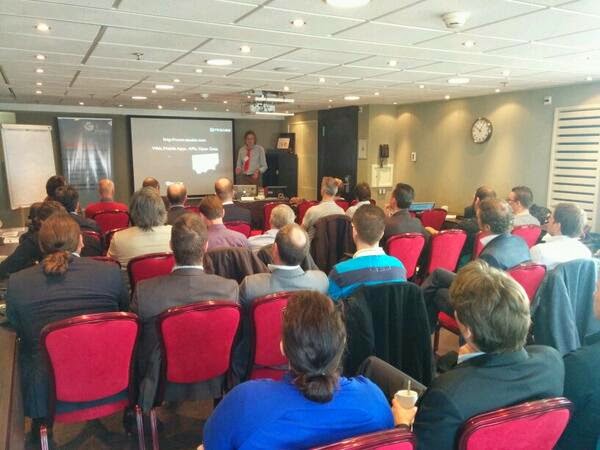
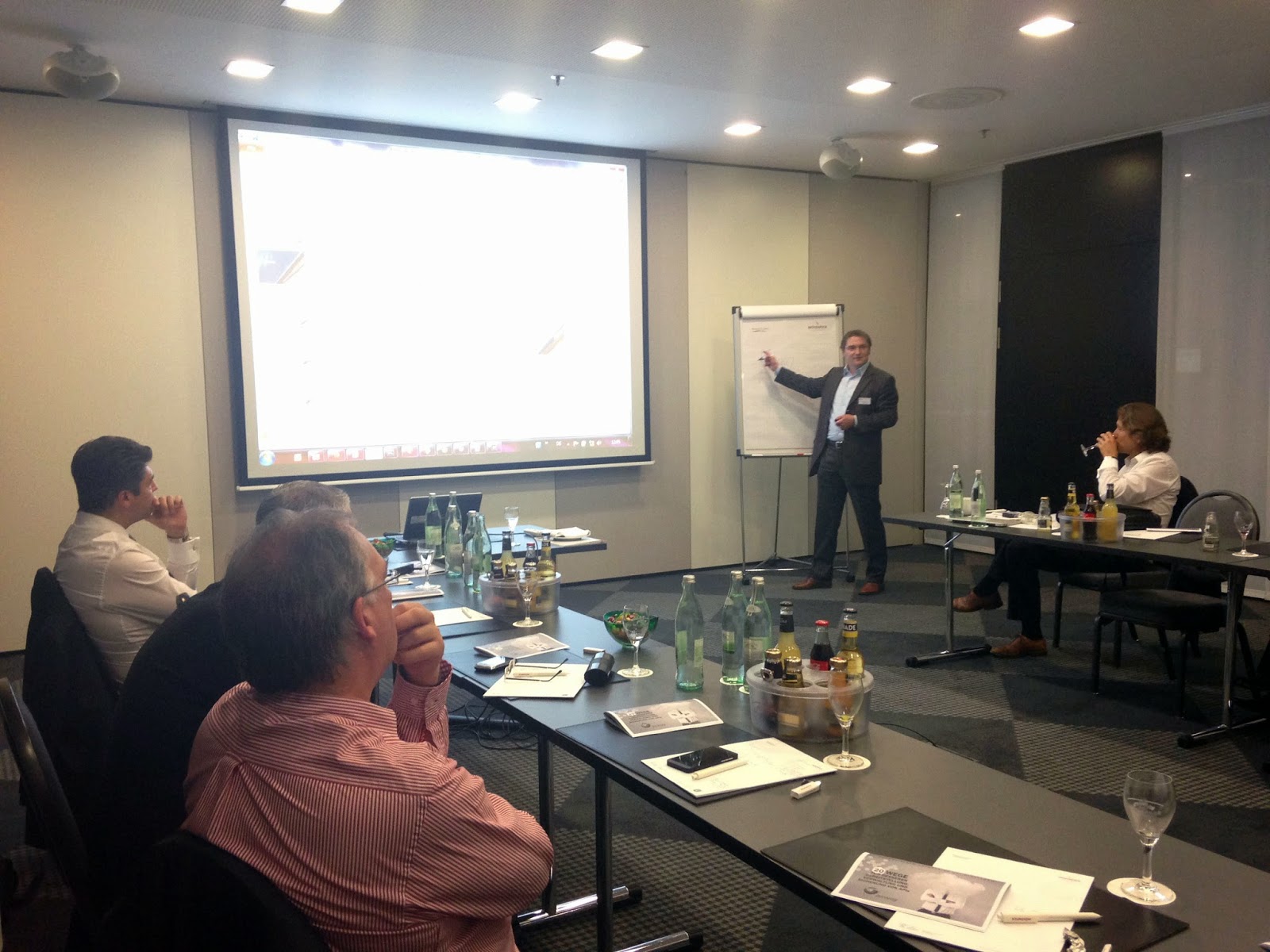
Berlin on 5 June, and Munich 10 July. In Berlin and Munich we are pleased to have Rafael Kobylinski (@rkobylinski), founder and CEO of incapptic, speaking about "Enterprise Apps - Dream or Nightmare" (auf Deutsch: “Enterprise Apps: Traum oder Albtraum?”). Our own René Kießling will also be in action - you can see him in action at our recent event in Stuttgart below:


So, wherever you are in the world, come along to a free API Workshop to learn about new technologies such as OAuth 2.0, see mobile API access in action, discover REST security, and mingle with fellow API practitioners. 

From "Why do we need an API?" to "Of course we have an API"

$
0
0
When Simon Redfern from the OpenBank Project presented a session at our API Workshop in the Netherlands last month, one particular slide really hit home to me. Simon talked about how, for banks, APIs are following the trajectory of Websites - from "Why do we need one?" to "Of course we have one":


This Thursday at our API Workshop event in New York City, there is another great chance to see Simon speaking about APIs for banking. If you work for a bank, generally in Financial Services, or just have an interest in the huge growth of APIs, I encourage you to go along. 

London Calling... REST APIs

$
0
0
Yesterday in London was the big day of Axway's API Workshop and Tech Lab. In the morning, we had excellent discussions led by Steve Craggs (@SteveCraggs) of Lustratus Research and Tim Haysom (@haysom_runner) of the GSMA. One of the themes was identity, in particular as related to Cloud identity and password security (or lack thereof...). We were then able to see standards such as OAuth 2.0 being used for "Sign in with Microsoft Live Connect" and "Sign in with Google" being enabled through the Axway API Gateway. 

In the afternoon was the hands-on Tech Lab portion, which you can see in action below (photo from my colleague Philipp Schone - @PhSchoene). In the Tech Lab, attendees could register APIs, connect up to the SalesForce API through the Axway API Gateway, and see API Management and monitoring in action. 


All in all, an excellent day. If you're in Sao Paolo next week, or in Berlin or Munich in June or July, I encourage you to come along to one of these events - it's a great opportunity to see API Management and security in action, and take part in some interesting discussions. 

Security for Internet of Things - OASIS Google Hangout discussion 27 May with Dan Blum & Jonathan Rodriguez

$
0
0
Security for Internet of Things is a hot topic. Just last week, our partner IC-Consult gave a talk about how BMW uses Secure APIs as a business enabler for the Connected Car. And tomorrow, I'm excited to be part of a Google Hangout discussion with Dan Blum and Jonathan Rodriguez about Security for Internet of Things. Update: The Security for Internet of Things discussion is now recorded and up on YouTube.

Today it seems everything is either already networked, or will be soon. Methods originally used to hook up office printers are now being applied to cars, wearable devices, building sensors and security systems and ... you name it. As more devices are added, we find ourselves questioning whether we are taking adequate security measures, using appropriate access control and privacy methods, and properly defining who owns the data.

Every one of these emerging "intelligent networks" -- ranging from systems in a home (appliances, heating, cooling, communications, entertainment) ... and business (security, inventory, HVAC and access) ... to the devices in your car, on your body (wearable monitors, geolocators and mini-smartphones) or even in it (diagnostic devices and caregiver-assistance sensors) ... is generating data. Often very informative and private data.

In the Google Hangout discussion about Security for Internet of Things, we will discuss:
  • Will there be an "SOA of Things" or a "Cloud of FitBits"? 
  • Do adequate security and access control methods exist for the IoT? 
  • Who owns the data? 
  • Can privacy rights be designed into the IoT? 
This debate happened on 27 May 2014, and you can view this Security for Internet of Things discussion recorded and up on YouTube.

Hybrid Integration via APIs - Session at Gartner EA Summit this Thursday June 5

$
0
0
This Thursday, June 5, I am presenting a session entitled "Enabling Hybrid Integration: How APIs bridge your Cloud, Mobile, and on-premises strategy" at the Gartner EA Summit in National Harbor, Maryland (right by Washington DC). The session is at 10.30am on Thursday morning.

Organizations require an integration strategy that links services together, irrespective of whether they are on-premises or in the Cloud. Hybrid Integration is the name given to this strategy, and it relies for its success on APIs. APIs are the link to Cloud services, since they are the basis of integration which Axway provides with services as diverse as SalesForce.com, Amazon Web Services, ServiceNow, and Google Apps. Secure APIs also provide a bridge to on-premises, through an API Gateway. In the session on Thursday, I'll talk about how effective API Management and SOA Governance strategy provides the basis for Hybrid Integration. Real-life examples are key here, to put it into perspective and provide clarity. So, I'll use examples from Axway's hybrid integration deployments worldwide.

The Gartner EA Summit is always an excellent event, with the right mix of high-level architecture discussion and implementation specifics. If you're going, I look forward to seeing you there - and feel free to reach out at my email address over on the right-hand-side of this page.

Secure APIs drive the Connected Car: Catch the webinar on BMW Group with IC-Consult

$
0
0
The Connected Car is hot. Just last week, Axway exhibited at Telematics 2014 in Detroit. And this Tuesday, we're excited to present a Webinar together with our partners IC-Consult on how Secure APIs drive the Connected Car at BMW Group.

Although the cases study is focused on the Connected Car, I'd encourage anyone interested in API Security in general to attend the webinar. Sebastian Mennicke, Senior Consultant at IC-Consult, is an expert on API security and he will be talking about how APIs are secured, including details of OAuth 2.0 in action. The webinar is at 10am US Eastern Time, so sign up here at the GoToMeeting site and I look forward to seeing you online. We'll have time at the end of the webinar for a Q&A session which I'm sure will be though-provoking, given the exciting nature of the Connected Car and Secure APIs.
Viewing all 236 articles
Browse latest View live


Latest Images